Valentina was a musician who had played the
piano a lot. As she said herself, from the first time she saw Chinese painting, she was
subjugated forever by this mighty art.
Chinese painting has a history that extends
back over many centuries. Over more than 2000 years of development artists have created
three main areas of painting: landscape, flowers and birds, and the portrait, and they
have invented two inter-related manners or styles of painting: gongbi - fine brush, and
the painting of ideas , xieyi or free brush. The first is distinguished by a highly
elegant and delicate manner of drawing, strict composition and a striving towards the
realistic representation of what is seen, while the second is distinguished by its sparse
brush-strokes, simplicity and laconic imagery. Chinese painting is more than just images
portrayed in ink on paper, it is centuries of Chinese philosophy and the history of
Chinese civilisation.
The distinguishing feature of Chinese
painting is the way it expresses the idea via the form. Having won a calligraphy contest
during my student years, I know from personal experience what is required to
"master" Chinese paper and ink. Valentina's pictures make it quite clear that
she has penetrated to the very heart of this complex art.
Having studied all the genres and styles,
Valentina has not merely copied Chinese themes, which is one of the main observances in
the acquisition of mastery and the transfer of the meaning and essence of Chinese painting
from generation to generation, she has striven to create her own style of painting. While
absorbing everything that is best from traditional painting, she creates her own works on
the basis of her own experience and practice. As the saying goes, "A journey of a
thousand li begins with the first step". I can say with certainty that the first step
has been taken, and taken successfully.
Valentina's works embody the poetry of
music and the music of poetry.
The Chinese proverb says, "Art is an
ocean without shores", but "The breadth of the ocean is for fishes to swim in,
and the height of the sky is for birds to fly in". Nothing remains for me but to wish
our respected artist every success in her work: may she swim to the shore of her dream and
soar in the sky like a bird in this vast ocean, the ocean of art.

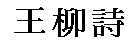
Li Yunquan, Doctor of Historical
Science,
Special Correspondent of the Chinese newspaper
"Guanming Zhibao"
Senior Researcher, The Institute of Social Development of Europe and Asia
at the Centre for Research into Problems of Development
of the State Council of the People’s Republic of China
Chinese painting has an ancient history. It
is distinguished not only by its unique technique and the distinctive ink used for drawing
by Chines artists, and the particular "xuan" paper, but also, of course,
by its exotic subjects, reflecting the ancient history and legends of China itself. It is
also distinctively informed by Chinese culture and philosophy and the wisdom of the East.
It offers not just a picture to be viewed, but to be read. A good piece of Chinese
art always forces the viewer to reflect, because it conceals a deep meaning.
The first time I saw Valentina’s works, I
simply could not believe they had been produced by a Russian artist. But when they told me
that Valentina had never made any formal study of Chinese painting or followed any
structured courses of study, I was simply astounded. Her works depict landscapes, flowers,
birds, people. They are painted in various styles, sometimes in a realistic descriptive
mode, sometimes in a distinctively free style in which conceptual content takes precedence
over formal likeness. As a European woman, Valentina follows her own taste in her
paintings. They represent the mingling of China and Europe, classical and contemporary. We
take pleasure in them not just because of their astounding beauty, we hear poems and music
too. Clearly these painting were not painted merely with the hand, but with the heart and
the soul. Works like this can only be created by a person who feels a tremendous love for
eastern culture, art and philosophy, someone who possesses a great talent.
I am sure her works will conquer the hearts
of all lovers of art. I sincerely wish her success and continued progress in the work she
loves.
Leonid Yakimovich,
Writing in "Asia and Africa Today"
… I have seen plenty of self-taught
Russian artists on Russian television, and there was always something amateurish about
their work. But here I had a sense of true professionalism. And this feeling is confirmed
by the Chinese themselves and by connoisseurs of Chinese painting."
From the author
I could never have painted in the Chinese
manner ("in Chinese") if I had known even a little about it beforehand. It is
like a leap from a river bank into the water, when the distance to the water keeps
increasing instead of decreasing. You plunge towards the river and you fall into a
bottomless abyss, infinite space. And for someone quite unacquainted with colour theory to
start with the most difficult of all tasks, Chinese painting, is tantamount to an attack
on art itself. But it was a strange story that brought me to this.
I received a very good musical education
and I was a good pianist. When I lived in Canada for a while, I gave piano lessons. By
chance or otherwise, all of my students were Chinese (Chinese children are like that –
they want to study). When I saw Chinese scroll paintings on the walls of one of their
houses I could physically feel my body vibrating as I walked past them. Every time I
rushed eagerly to that house in order to see - no, not to see, to feel this strange
magnetism. It was exactly like love.
Soon I had read every book about Chinese
painting that was to be found in the library. That is, I had read about the canons of the
genre. Almost nothing was said about the technique of this "craft", apart from a
few general comments. But that was quite understandable - the technical achievements are
the individual handwriting, which is developed over the years.
My impudence knew no bounds – I bought
brushes, paint, ink and paper in a random combination.... and I began, without the
slightest idea of how to "control" these mysterious things. I simply had no idea
that even the Chinese spend years tracing out hieroglyphs before "dashing off"
anything resembling a picture. I didn’t even know that the most important thing in
classic Chinese painting is the line's precise definition across its full range of
expression: wet and dry, short and long, dark and light, straight and bent. Or that it is
only the contrasting, rhythmical expressive power of these lines which renders the object
produced a rhythmical whole. Gradually I began to understand the nature of the lines, the
ink and paints, the symbolism: Chinese realistic painting no longer seemed merely a
beautiful and elegant rendition of objects and was transformed into an expression of the
essential formula of the object, with its internal dynamism. There were more and more
riddles to solve. The three-dimensional space and perspective to which my European vision
was accustomed were shattered against the fractured lines of Chinese landscape paintings.
At this point I grew totally confused. For a long time I tried to understand how the
Chinese had developed such an distinctive understanding of perspective. Here, however, I
can do no more than bow in submission to a great culture which combines the realistic
rendering of simple objects with a philosophic vision of unrivalled depth, founded on the
unity of the opposites of spirit and matter – yin and yang – the quintessence of
unity.
However, when my brush touched the paper it
produced only formless blobs. Thought, feeling and hand simply refused to fuse into one.
If not for the shock or the wound imparted by that strange energy, I might I have given
up. But clearly love is stronger even than the most difficult of difficulties.
You could say that all my works are autobiographical, since
each of them reflects my state at the time it was painted. The basic meaning of my art is
the reflection and creation of beauty. To be quite honest, I am absolutely sick of all the
monsters and freaks which now clutter entire museums and collections. After viewing these
objects of negative energy I somehow feel as though I should wash myself down with bleach
in order to scrub the stain of these "artistic horrors" out of my soul. Somehow
it has become the norm to portray "the sick self". Perhaps it was a desire for
purity and light which led me to Chinese painting, which stimulates thought and induces a
balanced psychological state akin to the experience of childhood or flight.
To me the spontaneity, harmony, elegance of line, symbolism
and lyrical spirit of Chinese painting are extremely attractive concepts. The philosophy
of classical Chinese painting has no place for western angst. Although at the present time
there is a certain tendency in China and the Chinese diaspora for painters to depart from
the major philosophical principles, this is not canonised as a movement in Chinese art.
Perhaps the reason that this astounding art does not perish is precisely that all of the
"dead-end routes" remain off-limits, so to speak. I think this is also a
manifestation of ancient Chinese wisdom. As for manifestations of individuality within the
strict canonical framework, there are as many as there are individual styles of
handwriting.
Chinese painting can be decoded like a picture-puzzle,
since it is founded on a specific code, the basis of which is the philosophy of the unity
of opposites.
This is a highly professional theme and I will not deal
with it here, since art historians have written dozens of books on the subject. However,
some of the judgements made by connoisseurs of art -- western art, I should emphasise --
who attempt to analyse, or rather commment on Chinese painting, are incorrect or even
fundamentally false, bearing not the slightest relationship whatsoever to this form of
painting.
At the present time a certain symbiosis is occurring
between the cultures of East and West, and it seems to me that if this is done with talent
it can only serve to enrich art as a phenomenon and Chinese painting in particular.
© VALENTINA BATTLER
all rights reserved